


The Master of Public Administration (MPA) program at McGeorge School of Law prepares students for leadership roles in public service, government agencies, and non-profit organizations. Designed for working professionals and pre-service students alike, the program offers a dynamic curriculum focused on policy analysis, public management, budgeting, and leadership skills.
With a hybrid learning model, students benefit from the flexibility of online coursework combined with valuable in-person Saturday sessions on campus. The McGeorge MPA program in Sacramento is located near the California State Capitol—a prime location for networking and hands-on learning.
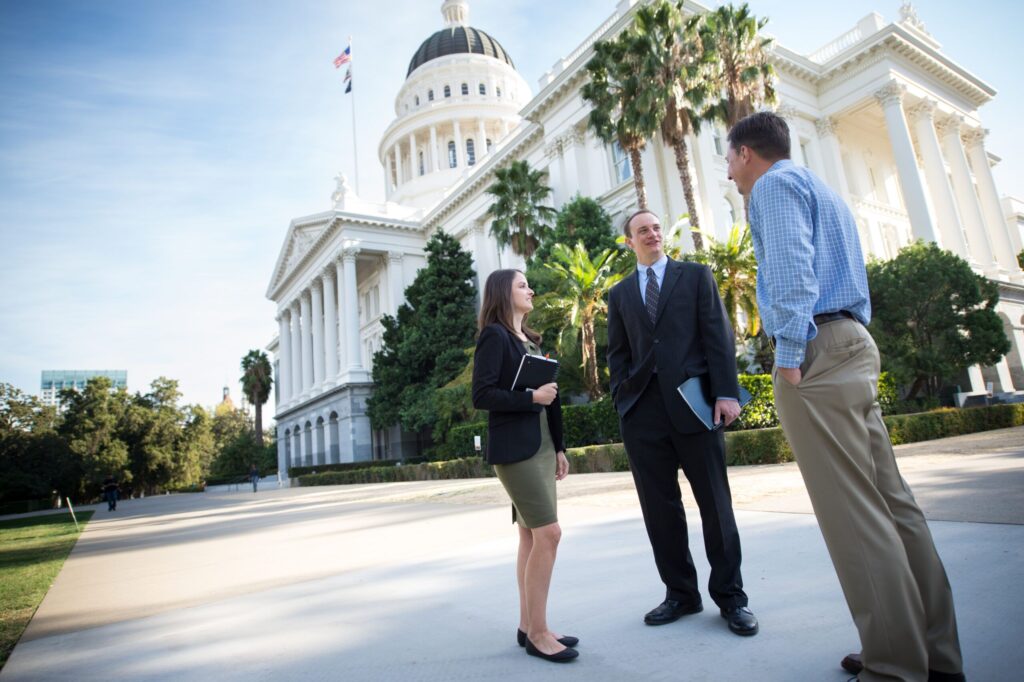


Students complete a combination of online and in-person coursework, with six to seven in-person Saturday sessions each semester. Most online courses are delivered synchronously in the evening, providing real-time interaction with professors and classmates while allowing working professionals to balance graduate study with career and personal commitments.
Fall and spring semesters are 15 weeks in length. All students take one required accelerated summer course, PUB 233. Students should expect regular interaction with faculty and peers, as well as additional time for coursework, assignments, readings, and applied projects outside of class.
This course provides students with an overview of the American legal system, including the sources of law and hierarchy of authority. The course is intended to develop an understanding of how lawyers read and analyze cases, statutes, and legal documents and provide an introduction to legal reasoning. The course will also focus legal research to familiarize students with locating and evaluating the weight of legal sources. Lastly, the course will discuss administrative law and the public process governing actions of administrative agencies.
This course introduces students to strategies and techniques for interpreting and applying statutes and regulations in the modern administrative state. Topics include foundational issues important to public law, such as the legislative process, doctrines of statutory interpretation, the structure of administrative law, and the role of agencies in interpreting and enforcing statutory schemes.
Analysis and development of knowledge and skills relevant to complex organizational behavior in public and nonprofit organizations, including motivation, diversity, communications, decision-making, power, conflict, culture, and change, with explicit attention to strategic leadership, managing human capital, group performance, and political and symbolic roles.
A foundation course in the theoretical and practical principles of public service at the federal, state, and local levels. It emphasizes the values fundamental to public action (equity, ethics, accountability, diversity), the roles of public servants and managers, and the knowledge and skills needed to achieve public purposes — covering constitutional foundations, bureaucratic structure, accountability and ethics, human resources, diversity, budgeting, and performance management.
Integrates learning from prior courses through self-assessment, class analysis of successful and unsuccessful public professionals, or a project for an actual client, with the goal of strengthening knowledge and competencies for long-term effectiveness. Much of the work is done in teams.
A structured introduction to the study and practice of public policy analysis. Students develop the conceptual frameworks and analytical tools to define policy problems, identify and evaluate alternatives, and formulate evidence-based recommendations, with emphasis on the political, institutional, and organizational contexts of policy decisions and methods such as cost-effectiveness analysis, benefit-cost reasoning, and stakeholder mapping.
Choose one of these two courses (3 Units):
Develops understanding of the role budgets play in state, local, and federal governance. It examines the politics of budgeting and the process of developing capital and operating budgets, gives hands-on experience with core budget and financial documents, and explores how economic cycles and past decisions shape budget options.
OR
Develops competence with the public-finance concepts and tools common to public policy professionals. It examines substantive and procedural requirements for various California public-agency revenue sources — taxes, assessments, fees, and charges — plus revenue estimation, capital facility financing, internal controls, fund accounting, and public investments.
Introduces the use of analytics in managing organizations and implementing programs or policies, providing a foundation in descriptive and inferential statistics — measures of central tendency and dispersion, probability, hypothesis testing and confidence intervals, correlation, and regression — and developing skills in identifying relevant analytics, collecting data, and making information usable for decision-makers.
Develops competence in economic concepts and tools drawn from microeconomics, including efficiency, equity, tax incidence, opportunity cost, cost-benefit analysis, incentives, marginal analysis, competition, public goods, and market failure, and provides opportunities to assess government programs and regulatory strategies from an economic perspective.
Elective and Concentration Courses: 3 units if no concentration; 9 units if a concentration is elected. With no concentration, students take any of the courses below or any law course, as discussed with their academic advisor.
Students gain a comprehensive understanding of the legal frameworks that safeguard our environment and water resources and develop the practical skills to advocate for sustainable environmental and water resource management.
Introduces the legal principles governing water allocation for human and environmental purposes, taught through in-person sessions and online work. Topics include surface and groundwater rights, management approaches, environmental allocation, federal-state relationships, tribal and reserved rights, reasonable use, waste, and the public trust doctrine.
A survey of legal principles and policies relating to protecting and enhancing the physical environment, with attention to common law doctrines and public remedies, plus federal and state control programs for air pollution, water pollution, noise, solid waste, and fish and wildlife resources.
Explores the challenge of providing a healthy environment and safe, affordable, reliable water to everyone regardless of race, ethnicity, gender, economic status, national origin, or education. Topics may include the human right to water, facility-siting impacts, toxic exposure, climate justice, food security, access to nature, and capacity building in disadvantaged communities. Limited to graduate students.
Students conduct in-depth exploration of legislative institutions and lawmaking processes; develop practical skills in drafting statutory language, preparing and assessing bill analyses, commenting on legislation, and actively participating in the legislative process; and become proficient in advocacy, negotiation, and compromise within policy-making settings.
A whole-course simulation providing practical experience researching, drafting, and pursuing adoption of state legislative and regulatory proposals. Students identify a client needing a law change, analyze deficiencies in current law, draft statutes or regulations, refine proposals for political realities, craft a strategy, and participate in a mock legislative hearing.
Develops skills for purposeful, enduring change to public policies and institutions, analyzing the roles and strategies of policy entrepreneurs, contrasting actions that strengthen versus weaken policies, and examining elected officials, stakeholders, and advocacy groups along with tools such as strategic communications, changed laws, new decision arenas, and altered financial incentives.
An online course examining legislative institutions and lawmaking in state and federal government, plus basic principles of judicial review of legislative action, with practice in skills such as drafting statutory language, preparing and assessing bill analyses, commenting on legislation, and participating in the legislative process. Open only to graduate students.
An online course exploring lobbying within U.S. state legislatures, with particular emphasis on legislative and regulatory advocacy in the California legislature, offering comparisons to other state legislatures and emphasizing practical skills for participating in state legislative and regulatory processes.
Examines the theoretical, ethical, cultural, and practical considerations essential to effective negotiations, taught through lecture, discussion, exercises, and role-plays. It covers best practices in preparation, strategy, and technique, contrasts competitive and collaborative approaches, and helps students identify strengths and weaknesses in their personal negotiating style.
Students develop the knowledge and skills to create significant and sustainable societal change with an emphasis on the capacity required for effective public action, including legal authority, technical competencies, fiscal resources, political support, and networked relationships.
A condensed overview of the governance, financial, human resource, and strategic concerns facing the nonprofit sector. Through readings, cases, and guest speakers, students examine the economic and policy environments nonprofits operate in, identify effective governance and management approaches, and explore measurement techniques.
Treats enhanced societal capacity as an overarching goal of public policy, noting that capacity to choose and act shapes the future and should be viewed globally. It stresses that progress isn’t synonymous with bigger government and examines a broad range of policymaking and implementation tools — from individual and family choice through expertise and program-assessment techniques.
Develops skills for purposeful, enduring change to public policies and institutions, analyzing the roles and strategies of policy entrepreneurs, contrasting actions that strengthen versus weaken policies, and examining elected officials, stakeholders, and advocacy groups along with tools such as strategic communications, changed laws, new decision arenas, and altered financial incentives.
Examines the theoretical, ethical, cultural, and practical considerations essential to effective negotiations, taught through lecture, discussion, exercises, and role-plays. It covers best practices in preparation, strategy, and technique, contrasts competitive and collaborative approaches, and helps students identify strengths and weaknesses in their personal negotiating style.
Students learn sophisticated techniques for evaluating and crafting effective public policies, statistical analysis and data-driven decision-making tools, and innovative strategies to boost community resilience and capacity, ensuring sustainable and impactful policy implementation.
Treats enhanced societal capacity as an overarching goal of public policy, noting that capacity to choose and act shapes the future and should be viewed globally. It stresses that progress isn’t synonymous with bigger government and examines a broad range of policymaking and implementation tools — from individual and family choice through expertise and program-assessment techniques.
Extends the statistical toolbox from Public Manager Analytics for use in policy analysis and program evaluation. By the end, students can estimate and interpret a variety of econometric models, with topics including multivariate regression, dummy variables, interaction effects, fixed effects, instrumental variables, time series, discontinuity models, and logistic regression.
Extends the introductory policy-analysis frameworks with more rigorous, integrative approaches to applied policy research. Students deepen their work on problem definition, alternative generation, and criteria selection while adding advanced techniques for projecting outcomes, evaluating tradeoffs, and addressing uncertainty, with attention to complex, multi-jurisdictional problems and analysis that can withstand stakeholder scrutiny.
Develops competence with the public-finance concepts and tools common to public policy professionals. It examines substantive and procedural requirements for various California public-agency revenue sources — taxes, assessments, fees, and charges — plus revenue estimation, capital facility financing, internal controls, fund accounting, and public investments.
Students examine city and regional governance structures and legal frameworks; develop practical skills in fiscal, administrative, and policy analysis; and apply these tools to real-world challenges in local government, with particular attention to California.
An introduction to the structures, functions, and challenges of local government administration with a focus on California. Students examine the legal, political, and organizational frameworks shaping city and metropolitan governance — municipal services, public safety, planning and economic development, intergovernmental relations, citizen engagement, and fiscal and administrative tools — through case studies and a project simulation.
A practical overview of local government law through the lens of housing law and policy. Students learn the source and limits of local governance authority through topics like federalism, state-municipality relations, local lawmaking, public and private finance, zoning, land use, and fair-housing and anti-discrimination laws, with a semester project engaging local decision-making.
Develops competence with the public-finance concepts and tools common to public policy professionals. It examines substantive and procedural requirements for various California public-agency revenue sources — taxes, assessments, fees, and charges — plus revenue estimation, capital facility financing, internal controls, fund accounting, and public investments.
Total Program Units: 30
Total Program Units: 36
The MPA is designed for working professionals and pre-service students preparing for leadership in public service. This program is especially beneficial for:
 Government and public agency staff moving into management and leadership rolesNon-profit professionals building budgeting, policy, and management skillsPre-service students launching a career in public administrationProfessionals pursuing roles such as city manager, program manager, or public sector consultant
The MPA is designed for working professionals and pre-service students preparing for leadership in public service. This program is especially beneficial for:
Government and public agency staff moving into management and leadership rolesNon-profit professionals building budgeting, policy, and management skillsPre-service students launching a career in public administrationProfessionals pursuing roles such as city manager, program manager, or public sector consultant
Phone:
916.739.7019
Email: graduatelaw@pacific.edu
3200 Fifth Ave. Sacramento, California 95817
Phone:
916.739.7019
Email:
graduatelaw@pacific.edu
Location:
3200 Fifth Ave.
Sacramento, California 95817