
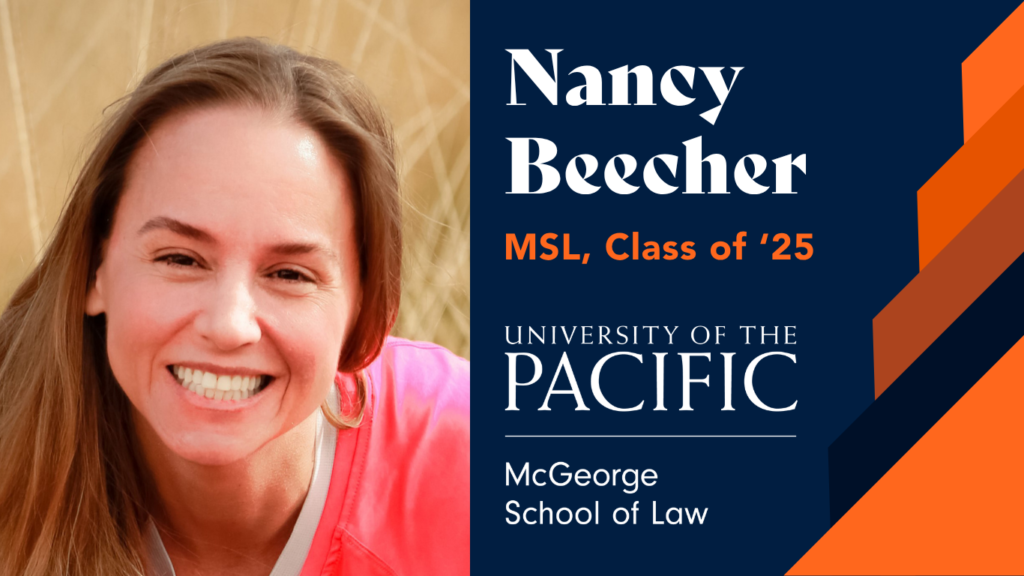
Understanding the law can complement an existing area of expertise for professionals working in fields shaped by complex regulations, and in a very powerful way. Earning a Master of Science in Law (MSL) in Water and Environmental Law from McGeorge School of Law gave Nancy Beecher, a Senior Environmental Research Analyst at the Southern Nevada Water Authority, a new way to apply her scientific background to her work.
With a Ph.D. in Ecology and Evolutionary Biology and nearly two decades of experience in the water profession, Nancy wasn’t looking to leave science behind. Instead, she wanted to understand how legal considerations could strengthen the scientific work she was already doing and vice versa. “I kept coming back to the intersection of science and law,” she says.
Her experience demonstrates how an MSL can serve as a resource for working professionals who want to expand their expertise, take on new responsibilities, and better understand the legal frameworks that shape their industries.
From Environmental Science to a Career in Water Resources
Nancy’s career began in environmental science. After earning a master’s degree in natural resource sciences and a Ph.D. in ecology and evolutionary biology, she joined the Southern Nevada Water Authority, where she has worked for nearly 20 years.
In her current role, Nancy helps safeguard the water supply for more than two million residents in the Las Vegas area. Her work involves helping ensure compliance with water and environmental law and informing land and water resource management. She synthesizes biological, hydrologic, geospatial, and legal information on a daily basis.
Before pursuing her MSL, Nancy had already worked with attorneys on matters including litigation briefs and expert biological reports for state water rights hearings. But she recognized a gap between her scientific expertise and the legal work surrounding it. “I entered McGeorge’s MSL program because I wanted to really understand how the law can or should inform my scientific analyses,” she says. “I wanted to convey scientific information to lawyers and judges in a way that makes sense to them, and ultimately, I wanted to help ensure that deliberations and outcomes are more fruitful for everyone.”
An Online MSL for Working Environmental Professionals
McGeorge’s online MSL program allowed Nancy to continue working and prioritizing her family life while earning her degree. The online format also gave her flexibility in how she accomplished her coursework, and she was still able to form lasting friendships with classmates.
She began seeing the value of the program almost immediately. After beginning classes, she watched a water-related hearing for work and realized that concepts she had just learned in the MSL program were helping her understand the discussion in a completely different way. Courses such as Water Resources Law and Executive Branch & Administrative State were particularly relevant to her work because of their connection to the legal and regulatory issues she encounters as an environmental professional.
Assignments also gave her opportunities to apply legal concepts to real-world water issues. In one course, she examined water development and water law in her local area, which gave her the opportunity to learn more about projects and work within her own organization from a different perspective. “I worked very hard to learn as much as I could during my classes, and I was diligent about applying that education to my job on a regular basis.”
Why Legal Education Matters for Environmental Professionals
Coming from a scientific background, Nancy found that studying law changed the way she approached problems. Science and law both require critical thinking and reasoning, but she quickly learned that the two fields approach evidence and analysis differently. In law, understanding precedent and how courts interpret issues is essential. Learning how attorneys and judges think through issues helped Nancy better understand how to communicate scientific information in a legally relevant way.
That knowledge became particularly useful in her day-to-day work. “I attained my goal of understanding how the law can or should inform my scientific analyses, effectively conveying scientific information to lawyers and judges, and helping ensure deliberations and outcomes are more fruitful,” she says. “I can now thoroughly integrate scientific data, analyses, and interpretation with legal elements to create effective evidentiary arguments that are more convincing to judges.”
Over time, her responsibilities evolved. Her manager began directing more work her way that combined science and law, and her job description came to explicitly include working with legal counsel and developing scientific and legal information for legal briefs and reports.
Expanding Your Expertise Without Leaving Your Field
Pursuing an MSL doesn’t necessarily mean changing careers or starting over; legal education can provide another tool for understanding and addressing the challenges encountered at work. Nancy’s scientific background remained at the center of her career, and the MSL gave her a stronger legal context.
“I have created a niche for myself,” she reports. “Few scientists have a legal education and can do what I do. Those unique abilities will continue to keep my career interesting and open up doors. I continue to see the value on a regular basis, and I’m so glad I received an MSL degree from McGeorge.”
For professionals in water resources, environmental science, policy, compliance, and related fields, an MSL in Water and Environmental Law can be a way to build on existing expertise while developing a deeper understanding of the legal issues that influence their work.